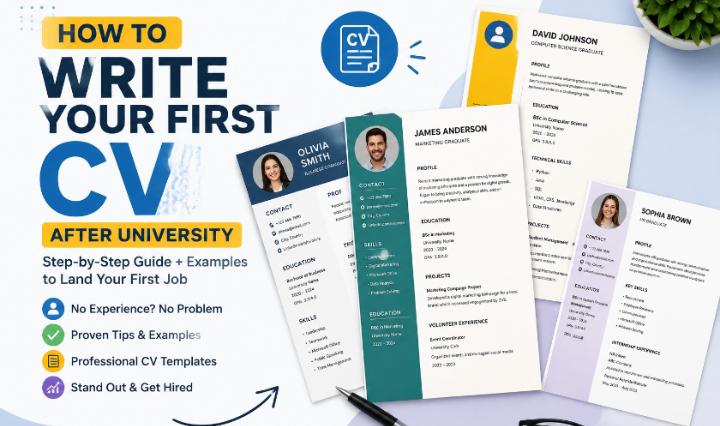

How to Write Your First CV After University: The Complete 2026 Guide
To write your first CV after university, lead with a short personal profile, list your education with relevant modules and grades, turn coursework and projects into achievement-based bullet points, add a skills section matched to the job description, and keep the whole document to one page in a clean, single-column, ATS-friendly format.
You've got the degree. You've got the late-night library sessions, the group projects that somehow came together, and a graduation photo you'll probably use as a profile picture for the next three years. What you don't have yet is a CV that actually gets you a reply.
That gap catches almost every graduate off guard. University teaches you how to write essays, lab reports, and dissertations — none of which prepares you for condensing your entire academic life into a single page that a recruiter will glance at for roughly seven seconds before deciding whether you're worth a second look. Add in the fact that most of your applications will pass through automated screening software before a human ever sees them, and it's easy to understand why so many talented graduates send out fifty applications and hear nothing back.
This guide walks through exactly how to build that first CV — from what to gather before you start writing, to the exact structure recruiters expect, to how to survive an Applicant Tracking System without turning your CV into a keyword-stuffed mess. By the end, you'll have a document that reflects what you actually bring to an employer, not just what you did in a lecture hall.
Why Your First CV Can Make or Break Your Career
It's tempting to think of your CV as a formality — something you write once and send everywhere. In practice, it's the single document standing between you and every interview you'll ever get in the early stage of your career. A weak CV doesn't just cost you one job. It quietly costs you every job you never hear back from, without ever telling you why.
What recruiters really look for in graduate CVs
Recruiters reviewing graduate applications aren't expecting ten years of experience — they know that. What they're actually scanning for is evidence of three things: can you communicate clearly, have you done anything that demonstrates initiative beyond the minimum coursework, and does your CV show you understand what this specific role actually involves. A CV that lists every module you ever took, with no sense of what mattered or what you achieved, tells a recruiter nothing about how you'll perform on the job.
Graduate recruiters at large firms typically spend under 10 seconds on an initial CV scan, according to widely cited eye-tracking studies from recruitment platforms — which means your most important information needs to be visible without any scrolling or searching. That's the entire logic behind everything in this guide: front-load the parts that matter, and cut anything that makes a recruiter work to find your value.
Why many fresh graduates never get interview invitations
The most common failure point isn't a lack of achievements — it's presentation. Graduates frequently write CVs that describe responsibilities instead of results ("Responsible for managing a team project" instead of "Coordinated a 4-person team to deliver a market research project two weeks ahead of deadline"). Others submit a single generic CV to every employer, which both human reviewers and ATS software can spot instantly. And a significant number simply get filtered out before a human ever opens the file, because their formatting choices — tables, columns, graphics, unusual fonts — broke the parsing software on the other end.
Before You Write Your CV: Prepare These Important Details
Writing a strong CV in one sitting from a blank page is genuinely difficult, even for people with years of experience. The graduates who end up with the strongest documents almost always do the preparation work first, then write.
Documents and information you should gather first
- Your final (or most recent) academic transcript, including module names and grades
- Your degree classification or GPA/CGPA, plus the grading scale your university uses
- Details of any internships, part-time jobs, volunteer roles, or society positions, including dates
- Any certifications, online courses, or technical training completed alongside your degree
- Contact information for two potential references (you don't list these on the CV itself, but have them ready)
- A copy of the job description(s) you're planning to apply to, so you can identify language to mirror
How to identify your strongest achievements after university
Most graduates underestimate what they've actually done, mainly because university experiences don't feel like "real" achievements the way a job title does. A useful exercise is to go back through your final two years and write down every situation where you: solved a specific problem, led or coordinated something, improved a process or outcome, or produced something measurable — a dissertation with a strong grade, a hackathon project, a society you helped grow, a part-time job where you were given more responsibility over time.
Once you have that raw list, look for numbers. Did your student society's membership grow? By how much? Did your final-year project involve analyzing a dataset of a certain size, or presenting to a certain number of people? Numbers are what separate a forgettable bullet point from one that sticks in a recruiter's memory.
The Perfect CV Structure Every Graduate Should Follow
Sections every professional graduate CV must include
| Section | What Goes Here |
|---|---|
| Contact Information | Full name, phone number, professional email, city, LinkedIn URL |
| Personal Profile | 2–3 sentence summary of who you are and what you offer |
| Education | Degree, university, graduation date, relevant modules, grade |
| Experience | Internships, part-time work, volunteering — with achievement bullets |
| Skills | Hard and soft skills matched to the target role |
| Projects (optional) | Academic, personal, or hackathon projects worth highlighting |
| Certifications (optional) | Relevant courses, licenses, or technical certifications |
How long should your first CV be?
One page. Almost without exception. Graduate recruiters expect a one-page CV, and going to two pages before you have several years of experience usually signals that you don't yet know how to prioritize information — which is, ironically, one of the exact skills the CV is meant to demonstrate. If you're struggling to fit everything on one page, that's a sign to cut weaker content, not shrink your font size until it's unreadable.
How to Write a Personal Profile That Gets Employers Interested
Your personal profile sits at the top of the page and is often the only part of your CV a recruiter reads in full before deciding whether to continue. It should answer three questions in two to three sentences: who are you, what do you offer, and what are you looking for. Avoid generic openers like "Hardworking and motivated graduate seeking opportunities" — this tells a recruiter nothing they couldn't assume already.
Examples of winning personal profile statements
Business graduate: "Business Management graduate from the University of Lagos with a First Class result and hands-on experience leading a 6-person student consulting project for a local retail client. Skilled in market research, financial modeling, and stakeholder communication, and looking to bring that analytical approach to a graduate role in strategy consulting."
Computer science graduate: "Computer Science graduate with a strong academic record and two internships building production features in Python and React. Built and shipped a personal project used by 200+ students to track exam schedules. Looking to join a software engineering team where I can keep learning while contributing from day one."
Common introduction mistakes that cost graduates interviews
- Starting with "I am" repeatedly, which reads as a list rather than a pitch
- Overusing adjectives like "passionate," "driven," or "dynamic" without backing them up with anything concrete
- Writing in the third person ("John is a graduate who..."), which feels oddly impersonal on a document that's already about you
- Making it too long. If your profile runs past four sentences, it's competing with your bullet points for attention it doesn't need
How to Present Your Education Like a Professional
As a first-time CV writer, your education section carries more weight than it will for the rest of your career — this is likely the strongest, most detailed proof of your ability that you currently have. Structure it clearly: degree title, university name, graduation month and year, and your classification or grade, followed by two or three lines on relevant modules, your dissertation topic, or standout academic achievements.
Should you include your GPA or CGPA?
Include it if it's strong — generally a First Class, a 3.5+ GPA on a 4.0 scale, or the equivalent in your grading system — since a strong result is one of the fastest ways to differentiate yourself from other graduate applicants. If your GPA is average or below, it's usually better to leave it off entirely and let your experience and skills carry the section instead; a recruiter is far less likely to reject you for an absent GPA than for a mediocre one sitting in plain view.
One detail that trips up a lot of international applicants: your CGPA or grade needs to be presented in a way the reader will actually understand. If you're applying to an employer in a country that uses a different grading scale than your university, converting your result accurately matters more than people expect — a strong CGPA that looks unremarkable after a bad conversion can genuinely cost you a callback. Our guides on converting CGPA to percentage using the correct university formula and whether GPA actually matters to employers are worth reading before you decide how to present yours. If you're applying with a UK degree classification to employers who expect a GPA-style number, our UK degree classification to GPA converter covers that conversion specifically, and our broader GPA calculator guide for international students explains why getting this number right carries more weight than most graduates assume.
How to highlight projects, research, and academic achievements
If you don't have paid work experience yet, your academic projects are your evidence. Treat your dissertation, final-year project, or any significant coursework the same way you'd treat a work achievement: what was the problem, what did you do, and what was the outcome. "Dissertation on consumer behavior in e-commerce, achieving a distinction grade, involving analysis of a 500-respondent survey dataset" tells a recruiter far more than "Completed dissertation."
No Job Experience? Here's Exactly What to Put on Your CV
This is the section that stresses out more graduates than any other, and it shouldn't. Almost nobody walks out of university with a stacked "Experience" section, and recruiters hiring for graduate roles know that. What they're actually evaluating is whether you've done anything, in any context, that demonstrates the skills the job needs.
How internships and volunteer work can strengthen your CV
Any internship, even an unpaid or short one, belongs in your Experience section written exactly like a job — company name, dates, and achievement-focused bullet points. Volunteering counts too, particularly if it involved responsibility: organizing an event, managing a budget, coordinating other volunteers, or communicating with the public. A part-time retail or hospitality job is also worth including, since it demonstrates reliability, customer communication, and the basic professionalism of showing up on time and handling a paycheck-driven responsibility — qualities that matter more to entry-level recruiters than people assume.
Turning university assignments into valuable experience
Group projects, case competitions, hackathons, and society leadership roles can all be framed the same way as work experience. A student who led a five-person team through a semester-long consulting case study has genuinely practiced project management, stakeholder communication, and deadline pressure — the same underlying skills a graduate scheme is trying to screen for. The trick is writing it with the same seriousness you'd give a real job, not tucking it away as an afterthought under "Extracurriculars."
The Skills Section: What Employers Actually Want to See
Top hard skills for fresh graduates
Hard skills should be specific and, wherever possible, verifiable — software you can actually use, languages you can actually speak, tools you've actually applied in a real project. Avoid vague entries like "Microsoft Office" without context; if you built financial models in Excel or ran statistical analysis in SPSS or Python, say that instead.
| Field | Hard Skills Worth Listing |
|---|---|
| Business / Finance | Financial modeling, Excel (advanced), data analysis, market research, PowerPoint/presentation design |
| Computer Science / Engineering | Python, Java, SQL, Git, cloud platforms (AWS/Azure), relevant frameworks |
| Marketing / Communications | SEO fundamentals, content writing, social media analytics, Canva/Adobe, campaign reporting |
| Sciences / Research | Lab techniques specific to your field, statistical software (R, SPSS), data collection methods |
Soft skills that can make you stand out
Soft skills only carry weight when they're demonstrated, not just listed. Rather than writing "Strong communication skills" as a standalone bullet, weave it into your experience section: "Presented quarterly project updates to a 20-person department" proves communication far more convincingly than the word itself ever could. The strongest graduate CVs treat soft skills as something shown through evidence elsewhere on the page, with the skills section reserved mainly for hard, verifiable abilities.
Real CV Example: A Graduate CV That Gets Interviews
Sample CV for a business graduate
Amara Okoye | amara.okoye@email.com | +234 XXX XXX XXXX | Lagos, Nigeria | linkedin.com/in/amaraokoye
PROFILE
Business Management graduate (First Class Honours) with hands-on experience in market research and financial analysis through a 6-person student consulting project. Seeking a graduate role in strategy or business analysis where I can apply strong analytical and communication skills from day one.
EDUCATION
BSc Business Management — University of Lagos (2022–2026), First Class Honours
Relevant modules: Financial Management, Strategic Analysis, Business Statistics
Dissertation: "Consumer Behavior Shifts in Nigerian E-Commerce" — Distinction
EXPERIENCE
Marketing Intern — Nova Retail Group, Lagos (Jun–Aug 2025)
• Analyzed customer purchase data across 3 store locations, identifying a pattern that informed a 15% reallocation of promotional budget
• Built a weekly sales-tracking dashboard in Excel, reducing manual reporting time by 4 hours a week
SKILLS
Financial modeling, Excel (advanced), market research, PowerPoint, stakeholder communication
Sample CV for an engineering or computer science graduate
Rohan Mehta | rohan.mehta@email.com | +91 XXXXX XXXXX | Bengaluru, India | github.com/rohanmehta
PROFILE
Computer Science graduate with two internships building production features in Python and React. Built and shipped a personal timetable app used by 200+ students. Looking to join a software engineering team where I can keep learning while contributing from day one.
EDUCATION
BTech Computer Science — VTU (2022–2026), CGPA 8.7/10
Relevant modules: Data Structures, Database Systems, Machine Learning
EXPERIENCE
Software Engineering Intern — Bytework Technologies (Jan–Jun 2025)
• Built and shipped 3 backend API endpoints used by 10,000+ daily active users
• Reduced page load time by 30% through query optimization in a Django application
PROJECTS
StudyTrack — Personal timetable and exam-reminder app (React, Node.js), 200+ active student users
SKILLS
Python, JavaScript, React, SQL, Git, AWS (basic)
Case Study: How One Graduate Got Hired Without Any Work Experience
Consider a fairly typical case: a Nigerian graduate finishing a BSc in Economics with a solid Second Class Upper result, no internships, and a first CV that read like an extended academic transcript — a list of every module taken, no bullet points, no numbers, and a two-page length. After forty applications and zero interview invitations, the CV was rewritten from scratch.
The mistakes they fixed on their CV
- Cut the CV from two pages to one, removing every module that wasn't directly relevant to the roles being applied for
- Replaced the module list with three achievement-based bullet points drawn from a final-year group project, including a specific statistic from the project's findings
- Added a volunteering role — treasurer of a student society — written with the same structure as a job, including a concrete achievement (managed a NGN 400,000 annual budget with zero discrepancies)
- Removed a generic personal profile and replaced it with a two-sentence summary naming the specific type of role being targeted
Lessons every graduate can learn from this success story
The rewritten CV didn't add any new experience — the graduate hadn't done anything new between the first version and the second. What changed was entirely presentation: turning a list of facts into a set of demonstrated achievements. Within three weeks of sending the new version, the graduate received two interview invitations. The lesson holds for almost every graduate in this position: the raw material is usually already there. The problem is almost always how it's written, not what happened.
Practical Tips to Make Your CV Stand Out From Hundreds of Others
Simple formatting tricks recruiters appreciate
- Use a single-column layout — two-column and sidebar designs frequently break when parsed by ATS software
- Stick to standard fonts (Arial, Calibri, Times New Roman) at 10–12pt
- Use consistent date formatting throughout (MM/YYYY is the safest choice)
- Leave generous white space rather than cramming content to fit one page — a cluttered page is harder to scan than a slightly shorter one
- Save and send as a PDF unless the application specifically requests otherwise; modern parsers handle PDFs reliably as of any system built after roughly 2018
Power words that instantly improve your CV
Swap passive, responsibility-focused language for active, outcome-focused verbs: instead of "Responsible for," use "Led," "Built," "Delivered," "Coordinated," "Analyzed," "Reduced," "Increased," or "Launched." These words shift a bullet point from describing a duty to describing an accomplishment, which is exactly the shift that separates a forgettable CV from a memorable one.
How to Customize Your CV for Every Job Application
Why sending the same CV everywhere rarely works
It's tempting, especially when you're applying to dozens of roles at once, to send one CV everywhere and hope volume compensates for precision. In practice, both human recruiters and ATS software can tell when a CV wasn't written with their specific role in mind — the language doesn't match the job posting, and the highlighted skills don't map cleanly onto what the role actually needs. A tailored CV doesn't need to be rewritten from scratch each time; it needs a master version you adjust for each application.
Using job descriptions to tailor your CV
Read the job description closely and note the specific terms it repeats — not just skills, but phrasing. If a posting says "cross-functional collaboration" and your CV says "worked with different teams," that's a mismatch worth fixing, since many ATS platforms score exact phrase matches higher than loosely related ones. Build a simple habit: highlight the five or six terms that appear most in the posting, then check that each one appears somewhere genuine in your CV — not stuffed in, but present where it's actually true.
How to Beat Applicant Tracking Systems (ATS)
What ATS software looks for in your CV
Modern ATS platforms like Workday, Greenhouse, and Lever have moved well beyond simple keyword matching. They now use machine learning to assess contextual relevance, flag manipulation attempts, and even weight where a keyword appears — a skill mentioned in your summary and reinforced in a bullet point scores higher than the same word buried once in a long list. What hasn't changed is the basic mechanics: your CV still needs to parse cleanly, with a single-column layout, standard section headers ("Experience," "Education," "Skills"), and no tables, text boxes, or embedded graphics that confuse the parser.
One outdated tactic worth explicitly avoiding: stuffing invisible white-on-white keyword text into a CV to game older keyword-matching systems. Current-generation ATS platforms actively detect this and can auto-reject an application with a fraud flag attached, and any hiring manager who opens the file directly will see it immediately too.
Keywords that can increase your chances of getting shortlisted
The most reliable keyword strategy is also the simplest: pull your keywords directly from the job description rather than a generic industry list, and place your strongest matches in three locations — your personal profile, your skills section, and the first bullet point under your most relevant experience entry. Prioritize exact phrase matches over your own paraphrased version of a skill, since many systems still weight literal matches more heavily than a implied synonym.
10 Common CV Mistakes Fresh Graduates Must Avoid
Small errors that can cost you an interview
- Spelling or grammar mistakes — even one typo can suggest carelessness to a recruiter reading hundreds of applications
- An unprofessional email address left over from school days
- Inconsistent formatting — mismatched fonts, spacing, or bullet styles across sections
- Listing duties instead of achievements ("Responsible for social media" instead of "Grew Instagram following by 40% over one semester")
- A CV longer than one page without years of relevant experience to justify it
- Using a two-column or graphic-heavy template that breaks ATS parsing
- Vague, unquantified bullet points with no numbers, timeframes, or scale
- Sending the exact same CV to every employer regardless of the role
- Missing or outdated contact information, including a LinkedIn profile that hasn't been updated to match the CV
- Including irrelevant personal details — marital status, religion, or a photo, none of which most employers expect or want on a CV
Things you should never include on your CV
Leave off your full home address (city and country are sufficient), your date of birth, salary expectations, and references — "References available on request" is understood and doesn't need to be written out. Avoid including weak or irrelevant hobbies purely to fill space; an empty line of white space looks more professional than a hobby that adds nothing to your candidacy.
Frequently Asked Questions About Writing Your First CV
Can I get a job without experience?
Yes. Most entry-level and graduate roles are built around the assumption that applicants have limited formal work experience. What matters more is how you present what you do have — academic projects, internships, volunteering, and part-time work — as evidence of the same underlying skills a job requires.
Should I include hobbies and interests?
Only if they're genuinely relevant or say something specific about you — captaining a sports team, running a niche blog, or competitive coding are all worth a line. Generic entries like "reading" or "socializing" rarely add value and are usually better left off in favor of white space or an extra achievement bullet.
Can I use the same CV for every job?
You can use the same base structure, but the content should shift depending on the role. Keep a detailed master CV with everything you might ever include, then trim and reorder it for each specific application so the most relevant information sits at the top.
How often should I update my CV?
Update it every time you complete something worth adding — a new project, a certification, a part-time role — rather than waiting until you need it urgently. A CV updated in the moment is far more accurate and detailed than one reconstructed from memory months later.
Should my CV and LinkedIn profile match exactly?
They should be consistent in the facts — job titles, dates, and education — but don't need to be word-for-word identical. LinkedIn can carry a slightly more conversational tone and additional detail your one-page CV doesn't have room for.
Is it okay to include a low GPA if I have strong experience?
Generally no — if your GPA is below what's typically expected in your field, it's usually better to omit it and let your experience, projects, and skills carry the education section. Very few employers will penalize an absent GPA, but many will notice a weak one.
Do I need a cover letter as well as a CV?
Many graduate applications still request one, and even when optional, a tailored cover letter can meaningfully strengthen an application by explaining context a CV can't — why this company specifically, and how your background connects to the role.
What file format should I submit my CV in?
PDF is the standard choice for nearly all applications, since it preserves formatting across devices and modern ATS platforms parse PDFs reliably. Only use a Word document if an application specifically requests one.
How do I explain a gap year or a lower-than-expected grade?
You generally don't need to explain either directly on the CV — save that context for an interview or cover letter if it comes up. Use the CV itself to focus on what you did during that time or since, rather than justifying what happened.
Should international students convert their grades for CVs sent abroad?
Yes, if you're applying to employers unfamiliar with your university's grading system, a brief clarification helps — for example, listing both your CGPA and its approximate percentage or classification equivalent. This is especially relevant for students weighing offers alongside international study abroad destinations, where employers may be used to a completely different grading scale than the one on your transcript.
Is it worth paying for a professional CV writing service?
For most graduates, no — the structure and advice in this guide covers what a paid service would typically deliver. It can be worth it if you're applying to a highly specialized field where industry-specific formatting conventions matter, but for the vast majority of graduate applications, a carefully self-written CV performs just as well.
Final Checklist Before Sending Your CV to Employers
A simple 10-point checklist to increase your chances of getting hired
| # | Check |
|---|---|
| 1 | CV is one page, single-column, and uses a standard font |
| 2 | Personal profile is tailored to the specific role, not generic |
| 3 | Every bullet point states an achievement or result, not just a duty |
| 4 | Numbers and specifics appear wherever possible |
| 5 | Keywords from the job description appear naturally in the text |
| 6 | No spelling or grammar errors (read it aloud, then have someone else check it) |
| 7 | Contact details and LinkedIn URL are current and correct |
| 8 | File is saved as a PDF with a professional file name (not "CV_final_v3") |
| 9 | No irrelevant personal details (address, date of birth, photo) |
| 10 | Formatting has been tested by copy-pasting the text into a plain document to confirm it parses cleanly |
My final assessment: Your First CV Is the First Step Toward Your Dream Career
Your first CV will not be perfect, and it doesn't need to be — it needs to be honest, specific, and structured in a way that lets a recruiter see your value in the few seconds they're willing to give it. Every graduate reading this has more evidence of their ability than they think; the work now is simply presenting it clearly.
Start with the checklist above, build a master version of your CV with everything you might ever include, then tailor a trimmed version for each application using the language from that specific job posting. Update it the moment you achieve something new, rather than scrambling to reconstruct your last two years from memory when a deadline is looming. Do that consistently, and your CV stops being a source of anxiety and becomes what it was always meant to be — a document that opens doors instead of quietly closing them.
Be the first to comment on this guide.
Leave a Comment
Comments are reviewed before appearing. Your email is never published.