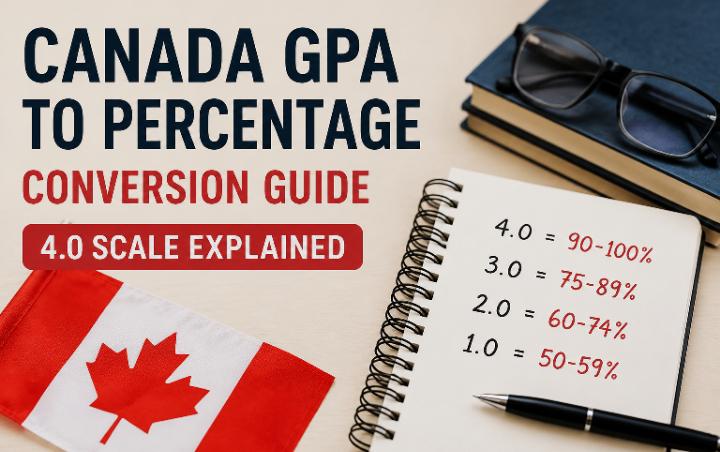

Canada GPA to Percentage Conversion Guide (4.0 Scale Explained)
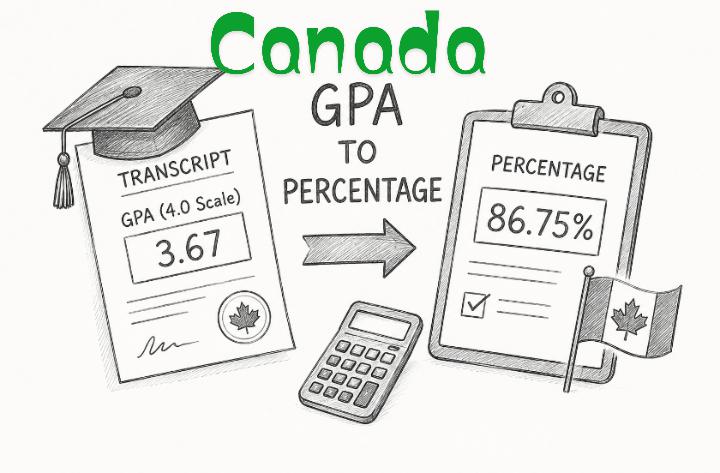
The Canada GPA to percentage conversion generally follows the formula Percentage = GPA × 25 on a standard 4.0 scale, so a 4.0 GPA equals roughly 100%, a 3.0 GPA equals roughly 75%, and a 2.0 GPA equals roughly 50%. Actual percentage bands vary slightly by university, so this guide includes both the general formula and the official scales used by real Canadian institutions.
Somewhere between your transcript and the scholarship form asking for your "percentage average," there's a gap that trips up more students than you'd expect. Canadian universities report grades on a 4.0 (or 4.33) GPA scale, but a lot of the outside world — international employers, foreign universities, government scholarship portals — still wants a percentage. If you've ever typed "what is my 3.4 GPA in percentage" into a search bar at 11pm before an application deadline, this guide exists for exactly that moment.
What follows is a complete Canada GPA to percentage conversion guide covering every 0.1 increment from 4.0 down to 0.1, explained against both a general conversion formula and the official grading scales published by real Canadian universities. You'll also find the answers to the questions students ask most about how this system actually works, why it isn't identical everywhere, and how to use your converted percentage with confidence on an application.
Understanding How GPA to Percentage Conversion Works in Canada
Before jumping into the numbers, it helps to understand why this conversion isn't as simple as most online calculators make it look. Canadian universities don't all use the same GPA scale. The University of Toronto uses a 4.0 scale where both A+ and A are worth 4.0 points. The University of British Columbia uses a 4.33 scale, where an A+ is worth more than a straight A — a distinction that doesn't exist at most Ontario schools. McGill, meanwhile, reports many of its grades directly as percentages rather than converting everything to a GPA at all.
Because of that variation, this guide uses the most common general-purpose formula for estimating a percentage from a 4.0-scale GPA:
This formula is useful for a quick estimate, but it's worth being direct about its limits: real Canadian universities don't grade on a smooth, linear curve. Official transcripts use stepped percentage bands, where a range of marks (say, 85% to 89%) all earn the exact same GPA value. That means the linear formula above will sometimes land slightly higher or lower than what your official transcript actually shows. For example, the University of Toronto's official grading scale assigns a full 4.0 to any percentage between 85% and 100%, while the linear formula would only give a 4.0 GPA the value of exactly 100%. Likewise, UBC's official grading practices place a B+ between 76% and 79%, rather than at one fixed number. If you're using your converted percentage for something formal — a scholarship, a visa application, a foreign university transfer — it's worth cross-checking your specific institution's own conversion table, or requesting an official statement from your registrar's office, rather than relying on the estimate alone. For credential recognition purposes at a national level, the Canadian Information Centre for International Credentials (CICIC) is the authoritative government-affiliated resource for how Canadian qualifications are understood internationally.
With that context in place, here's the full Canada GPA to percentage conversion, broken down in 0.1 increments so you can find your exact GPA and see what it means.
Canada GPA to Percentage Conversion (4.0 Scale)
| GPA | Percentage (GPA × 25) | GPA | Percentage (GPA × 25) |
|---|---|---|---|
| 4.0 | 100% | 2.0 | 50% |
| 3.9 | 97.5% | 1.9 | 47.5% |
| 3.8 | 95% | 1.8 | 45% |
| 3.7 | 92.5% | 1.7 | 42.5% |
| 3.6 | 90% | 1.6 | 40% |
| 3.5 | 87.5% | 1.5 | 37.5% |
| 3.4 | 85% | 1.4 | 35% |
| 3.3 | 82.5% | 1.3 | 32.5% |
| 3.2 | 80% | 1.2 | 30% |
| 3.1 | 77.5% | 1.1 | 27.5% |
| 3.0 | 75% | 1.0 | 25% |
| 2.9 | 72.5% | 0.9 | 22.5% |
| 2.8 | 70% | 0.8 | 20% |
| 2.7 | 67.5% | 0.7 | 17.5% |
| 2.6 | 65% | 0.6 | 15% |
| 2.5 | 62.5% | 0.5 | 12.5% |
| 2.4 | 60% | 0.4 | 10% |
| 2.3 | 57.5% | 0.3 | 7.5% |
| 2.2 | 55% | 0.2 | 5% |
| 2.1 | 52.5% | 0.1 | 2.5% |
Now let's go through each value individually, since the context around a GPA — what letter grade it typically represents, whether it clears a common admissions or scholarship bar — matters just as much as the raw percentage.
What Is 4.0 GPA in Percentage in Canada?
A 4.0 GPA converts to 100% using the standard formula, though on most official Canadian scales a 4.0 simply represents the top band — at the University of Toronto, that's anything from 85% to 100% (A or A+). A 4.0 GPA is the maximum on most Canadian university scales and reflects consistently excellent academic performance across your coursework.
What Is 3.9 GPA in Percentage in Canada?
A 3.9 GPA converts to roughly 97.5%. This sits comfortably within the A range at nearly every Canadian institution and reflects near-perfect academic consistency, the kind of record that clears the bar for almost any scholarship or graduate program with a minimum GPA requirement.
What Is 3.8 GPA in Percentage in Canada?
A 3.8 GPA converts to approximately 95%. Like 3.9, this still falls within the A band on most Canadian scales and represents an exceptionally strong academic record, well above the threshold most competitive graduate programs and merit scholarships look for.
What Is 3.7 GPA in Percentage in Canada?
A 3.7 GPA converts to about 92.5% under the linear formula, though on official scales like U of T's, a GPA of 3.7 corresponds to an A- band, typically 80% to 84%. This is a genuinely strong GPA and puts most students comfortably on their faculty's Dean's List.
What Is 3.6 GPA in Percentage in Canada?
A 3.6 GPA converts to roughly 90%. This is a strong A-range result on most scales and reflects consistent, high-quality academic work — the kind of GPA that's competitive for merit-based scholarships and most master's program admissions.
What Is 3.5 GPA in Percentage in Canada?
A 3.5 GPA converts to approximately 87.5%. This is often cited as the informal cutoff for Dean's List recognition at several Canadian universities and is generally considered a strong, competitive GPA for graduate school applications.
What Is 3.4 GPA in Percentage in Canada?
A 3.4 GPA converts to about 85%. This typically sits right at the edge of the A range and represents solid, above-average academic performance that comfortably meets most program admission requirements.
What Is 3.3 GPA in Percentage in Canada?
A 3.3 GPA converts to roughly 82.5% under the linear formula, and corresponds to a B+ on official scales like U of T's, generally in the 77% to 79% range. This is a solid, respectable GPA that meets the bar for most graduate program applications.
What Is 3.2 GPA in Percentage in Canada?
A 3.2 GPA converts to approximately 80%. This falls within the B+ range on most institutional scales and reflects consistently good academic performance, generally well above the minimum requirement for continuing in most degree programs.
What Is 3.1 GPA in Percentage in Canada?
A 3.1 GPA converts to about 77.5%. This sits comfortably within the B+ to B range and represents solid academic standing, typically sufficient for most standard graduate program admission thresholds.
What Is 3.0 GPA in Percentage in Canada?
A 3.0 GPA converts to roughly 75%, corresponding to a straight B on most official Canadian scales. A 3.0 is frequently cited as the minimum GPA requirement for graduate school admission in Canada, making it an important benchmark for students planning to continue their education.
What Is 2.9 GPA in Percentage in Canada?
A 2.9 GPA converts to approximately 72.5%. This sits just under the common 3.0 graduate admission threshold, which means students in this range may need to strengthen other parts of their application, such as references or a strong statement of intent, when applying to graduate programs.
What Is 2.8 GPA in Percentage in Canada?
A 2.8 GPA converts to about 70%, generally within the B- range. This is a respectable, above-average result that satisfies continuation requirements at most Canadian universities, though it may fall short of some competitive scholarship cutoffs.
What Is 2.7 GPA in Percentage in Canada?
A 2.7 GPA converts to roughly 67.5%. On most official scales this sits in the B- to C+ range and reflects solid, satisfactory academic performance without being especially competitive for merit-based funding.
What Is 2.6 GPA in Percentage in Canada?
A 2.6 GPA converts to approximately 65%. This generally falls in the C+ range and represents adequate academic standing — sufficient to remain in good standing at most institutions, though below the level most graduate programs prefer to see.
What Is 2.5 GPA in Percentage in Canada?
A 2.5 GPA converts to about 62.5%. This is frequently referenced as a general minimum GPA for undergraduate admission at many Canadian universities, making it a meaningful benchmark for prospective students, even though it sits below most graduate admission thresholds.
What Is 2.4 GPA in Percentage in Canada?
A 2.4 GPA converts to roughly 60%, generally within the C range. This reflects satisfactory but unremarkable academic performance and may limit eligibility for some competitive programs or scholarships.
What Is 2.3 GPA in Percentage in Canada?
A 2.3 GPA converts to approximately 57.5%. This sits within the C to C+ range on most scales and represents passing, adequate academic performance, though students in this range are generally advised to focus on improving their standing before applying to competitive programs.
What Is 2.2 GPA in Percentage in Canada?
A 2.2 GPA converts to about 55%, typically within the C range. This is a passing GPA at most institutions, though it sits meaningfully below the 3.0 benchmark commonly expected for graduate study.
What Is 2.1 GPA in Percentage in Canada?
A 2.1 GPA converts to roughly 52.5%, generally in the C to C- range. This reflects marginal but passing academic performance and may trigger academic advising conversations at some universities, depending on faculty-specific standing requirements.
What Is 2.0 GPA in Percentage in Canada?
A 2.0 GPA converts to approximately 50%, corresponding to a C on most official scales. This is a commonly cited minimum GPA for maintaining good academic standing and program continuation at many Canadian universities, making it an important threshold to stay above.
What Is 1.9 GPA in Percentage in Canada?
A 1.9 GPA converts to about 47.5%. This falls below the 2.0 threshold that many programs use to define good academic standing, and students in this range may be placed on academic probation depending on their faculty's specific policies.
What Is 1.8 GPA in Percentage in Canada?
A 1.8 GPA converts to roughly 45%, generally in the C- to D range. This is below the typical good-standing threshold at most institutions and usually signals a need for academic support or a change in study strategy.
What Is 1.7 GPA in Percentage in Canada?
A 1.7 GPA converts to approximately 42.5%. This sits within the D range on most scales and reflects below-average academic performance that most Canadian universities would flag for academic advising or probation review.
What Is 1.6 GPA in Percentage in Canada?
A 1.6 GPA converts to about 40%. This is generally considered a weak academic record and typically falls below the minimum GPA most faculties require for continued enrollment without formal review.
What Is 1.5 GPA in Percentage in Canada?
A 1.5 GPA converts to roughly 37.5%, within the D range. At this level, most Canadian universities would place a student under some form of academic monitoring, and continuing in the same program without improvement becomes increasingly difficult.
What Is 1.4 GPA in Percentage in Canada?
A 1.4 GPA converts to approximately 35%. This reflects a struggling academic record, generally well below the threshold needed to remain in good standing, and would typically warrant a serious conversation with an academic advisor.
What Is 1.3 GPA in Percentage in Canada?
A 1.3 GPA converts to about 32.5%, within the D to D- range. At this level, academic probation is a realistic outcome at most Canadian institutions, and the priority becomes stabilizing performance rather than pursuing competitive programs.
What Is 1.2 GPA in Percentage in Canada?
A 1.2 GPA converts to roughly 30%. This is a low GPA by any Canadian institutional standard and generally falls within the range that triggers formal academic review or probation.
What Is 1.1 GPA in Percentage in Canada?
A 1.1 GPA converts to approximately 27.5%, within the D- range. This is close to the lowest passing grade band on most scales and reflects a record that needs significant improvement to avoid program dismissal.
What Is 1.0 GPA in Percentage in Canada?
A 1.0 GPA converts to about 25%, corresponding to a D on many official scales. This is generally the lowest GPA still associated with a passing letter grade band at most Canadian universities, sitting right at the edge before performance is classified as failing.
What Is 0.9 GPA in Percentage in Canada?
A 0.9 GPA converts to roughly 22.5% under the linear formula. It's worth noting that on most real Canadian transcripts, any percentage below 50% is recorded as an F worth 0.0 GPA points — so a 0.9 GPA wouldn't actually appear on an official transcript; this figure is a mathematical estimate only.
What Is 0.8 GPA in Percentage in Canada?
A 0.8 GPA converts to approximately 20% using the linear formula. As with 0.9, this range falls below what any standard Canadian university scale actually assigns — official transcripts collapse everything under 50% into a single failing grade rather than issuing fractional GPA values in this band.
What Is 0.7 GPA in Percentage in Canada?
A 0.7 GPA converts to about 17.5% under the linear formula, though interestingly, 0.7 is also the exact GPA value the University of Toronto assigns to a D-, which covers percentages from 50% to 52%. This is one case where the formula estimate and the real institutional value diverge noticeably.
What Is 0.6 GPA in Percentage in Canada?
A 0.6 GPA converts to roughly 15% under the linear formula. Like the lower values above, this doesn't correspond to a real grade band on most Canadian transcripts, since anything below 50% is simply recorded as a fail worth 0.0 GPA points.
What Is 0.5 GPA in Percentage in Canada?
A 0.5 GPA converts to approximately 12.5% under the formula. This value is a mathematical estimate only — on official Canadian transcripts, a GPA this low doesn't reflect how failing grades are actually recorded.
What Is 0.4 GPA in Percentage in Canada?
A 0.4 GPA converts to about 10% under the linear formula, again purely as a mathematical estimate. In practice, a student's cumulative GPA can fall into this range through a mix of passing and failing courses, even though no single course would be recorded at exactly this GPA value.
What Is 0.3 GPA in Percentage in Canada?
A 0.3 GPA converts to roughly 7.5% under the formula. A cumulative GPA this low generally indicates a student is significantly behind their program's continuation requirements and would almost certainly be facing academic dismissal proceedings at most Canadian institutions.
What Is 0.2 GPA in Percentage in Canada?
A 0.2 GPA converts to approximately 5% under the linear formula. This extremely low range would typically only occur with multiple failed courses across a term and would trigger the most serious level of academic standing review at almost any Canadian university.
What Is 0.1 GPA in Percentage in Canada?
A 0.1 GPA converts to about 2.5% under the formula, sitting just above a flat 0.0. At this level, a cumulative GPA reflects an academic record in serious difficulty, and students in this range would typically already be engaged in formal academic standing procedures with their university.
What Counts as a Good GPA in Canada?
| GPA Range | General Standing |
|---|---|
| 3.7 – 4.0 | Excellent — competitive for top graduate programs and major scholarships |
| 3.3 – 3.6 | Very good — strong candidate for most graduate funding and honors |
| 3.0 – 3.2 | Good — meets typical minimum graduate admission requirements |
| 2.5 – 2.9 | Satisfactory — generally acceptable for undergraduate continuation |
| 2.0 – 2.4 | Below average — meets minimum good standing at most schools |
| Below 2.0 | At risk — often triggers academic probation review |
These bands are general reference points rather than fixed rules — every faculty sets its own specific probation and honors thresholds, so always confirm the exact figures with your university's academic regulations.
Case Study: A Nigerian Student Converting Their Result for a Canadian Application
Consider a Nigerian student with a strong First Class CGPA applying to a Canadian master's program that lists a minimum requirement of "75% or a B average." Rather than guessing, the smartest move is working backward from the Canadian scale: 75% corresponds to roughly a 3.0 GPA using the linear formula, which lines up with the B-average language in the program's requirements. Before submitting, it's worth converting the original CGPA accurately using the home university's official formula — our India CGPA to percentage guide covering every university formula and our broader CGPA to percentage guide with every formula both walk through exactly how to do that without underselling a strong transcript. For students specifically weighing Canada as a destination, our guide to the best countries to study abroad in 2026 covers how Canada compares to other major destinations on cost and post-study work rights.
Frequently Asked Questions About Canada GPA to Percentage
How Do You Convert GPA to Percentage in Canada?
The most common general formula is Percentage = GPA × 25 on a standard 4.0 scale. This gives a reasonable estimate, but your actual percentage may differ slightly depending on your specific university's official grading bands.
Is There an Official GPA to Percentage Conversion in Canada?
No single official national conversion exists — each Canadian university publishes its own grading scale and percentage bands. The University of Toronto and UBC, for example, use different scales entirely (4.0 versus 4.33), so always check your specific institution's registrar page for the exact figures.
Why Does GPA to Percentage Vary Between Canadian Universities?
Because each university sets its own grade bands independently. Some schools group a wider percentage range into a single GPA value, while others use narrower bands, which is why the same percentage can produce a slightly different GPA depending on where you studied.
Can I Convert My CGPA to a Canadian Percentage?
Yes, though you should first confirm what scale your CGPA is reported on (commonly 10-point or 4-point scales are used internationally). Once you know your CGPA's scale, you can apply the equivalent proportional formula to estimate a Canadian-style percentage.
How Do Canadian Universities Calculate GPA?
Most Canadian universities calculate GPA as a credit-weighted average: each course's grade point value is multiplied by its credit weight, those totals are summed, and the result is divided by the total credits attempted.
What Percentage Is a 4.0 GPA in Canada?
Using the standard formula, a 4.0 GPA equals 100%, though on most official university scales, a 4.0 simply represents the top grade band — often anywhere from 85% to 100%, depending on the institution.
What Percentage Is Considered an A Grade in Canada?
Most Canadian universities define an A grade somewhere between 80% and 89%, with A+ typically starting at 90%. The exact cutoffs vary slightly by institution, so it's worth checking your specific university's published scale.
Is a 3.5 GPA Good in Canada?
Yes, a 3.5 GPA is generally considered strong across Canadian universities, often meeting Dean's List thresholds and comfortably clearing the minimum requirements for most graduate program applications.
Is a 3.0 GPA Good for Studying in Canada?
A 3.0 GPA is generally considered solid and meets the common minimum requirement cited by many graduate programs in Canada, though highly competitive programs may expect something closer to 3.3 or above.
What GPA Do You Need for a Master's Degree in Canada?
Most Canadian graduate programs list a minimum GPA of around 3.0 out of 4.0 (or a B average) for admission, though competitive programs at top-ranked universities often expect 3.3 or higher.
What GPA Is Required for Scholarships in Canada?
Requirements vary widely by scholarship, but many merit-based awards expect a GPA of 3.5 or higher, while some entrance scholarships accept 3.0 or above. Always check the specific scholarship's published eligibility criteria before applying.
How Accurate Are Online Canada GPA to Percentage Calculators?
They provide a reasonable estimate using a standard linear formula, but they can't account for every university's unique grading bands. For anything formal, cross-check the estimate against your specific institution's official scale.
Can International Students Convert Their GPA to a Canadian Percentage?
Yes, international students can estimate a Canadian-style percentage from their home GPA by first identifying their original scale's maximum value, then applying the equivalent proportional formula used in this guide.
Is the Canada GPA Scale the Same in Every Province?
No. GPA scales are set at the institutional level, not provincially, which is why universities within the same province — and even within the same city — can use different scales and percentage bands.
What Is the Difference Between GPA, CGPA, and Percentage in Canada?
GPA typically refers to your average for a single term, CGPA (cumulative GPA) covers your entire academic record to date, and percentage is the raw marks-based score before it's converted into a grade point value.
Can I Use My Percentage to Calculate My Canadian GPA?
Yes, by reversing the formula: GPA = Percentage ÷ 25 gives a general estimate, though your specific university's official percentage-to-GPA table will give a more accurate figure for your transcript.
Which Canadian Universities Use a 4.0 GPA Scale?
Many Ontario universities, including the University of Toronto, use a standard 4.0 GPA scale. Other institutions, like UBC, use a 4.33 scale instead, so it's important to confirm which scale applies to your specific school.
What Is a Good GPA in Canada for University Admission?
For undergraduate admission, many Canadian universities look for a GPA in the 2.5 to 3.0 range or higher, though highly competitive programs and universities often expect significantly higher averages.
Does Canada Use a 4.0 or 4.33 GPA Scale?
Both scales are used, depending on the institution. Most Ontario universities use 4.0, while UBC notably uses 4.33. Always confirm which scale your specific university or program uses before converting your GPA.
How Can I Easily Convert My GPA to a Percentage for Canada?
The fastest method is applying the general formula (GPA × 25) for a quick estimate, then verifying against your specific university's official grading scale if the converted percentage will be used for something formal, like a scholarship or visa application.
Final Thoughts: Getting Your Canada GPA to Percentage Conversion Right
The general Canada GPA to percentage formula in this guide — GPA × 25 — is a reliable starting point for almost any quick estimate you need, whether you're checking eligibility before applying somewhere or just trying to understand where you stand. But treat it as exactly that: a starting point. When the number you submit actually matters — a scholarship application, a graduate school requirement, a government form — take the extra few minutes to check your specific university's official grading scale, or request a formal statement from your registrar's office.
If you're applying internationally and need to go the other direction — converting a foreign CGPA into something a Canadian admissions officer will understand at a glance — start with your home university's official conversion formula rather than a generic multiplier, and present both numbers side by side wherever the application allows it. That combination gives whoever's reviewing your file everything they need, regardless of which grading system they're used to.

Be the first to comment on this guide.
Leave a Comment
Comments are reviewed before appearing. Your email is never published.